What Is OCPP? A Complete Guide to the EV Charging Communication Protocol
Whether you're installing a home EV charger or planning a large-scale commercial charging site, OCPP is the key technical standard you need to know. This guide explains what OCPP is, why it matters, and how to choose the right equipment — from the ground up.
| Table of Contents |
|
3. OCPP 1.6 vs. OCPP 2.0.1 — What's the Difference?
4. Who Should Care About OCPP?
5. How to Verify OCPP Support When Buying a Charger
|
1. What Is OCPP?
OCPP, short for Open Charge Point Protocol, is the common language that allows EV charging stations (charge points) to communicate with a back-end Charging Station Management System (CSMS).Think of it as the "USB standard" for the EV charging world — no matter which brand of charger you use, as long as it follows the OCPP protocol, it can integrate with the same back-end platform to enable remote monitoring, billing, fault detection, and more.
💡 Simply put: OCPP lets chargers "understand" commands from the back-end system — and lets the back-end "see" real-time charger status.
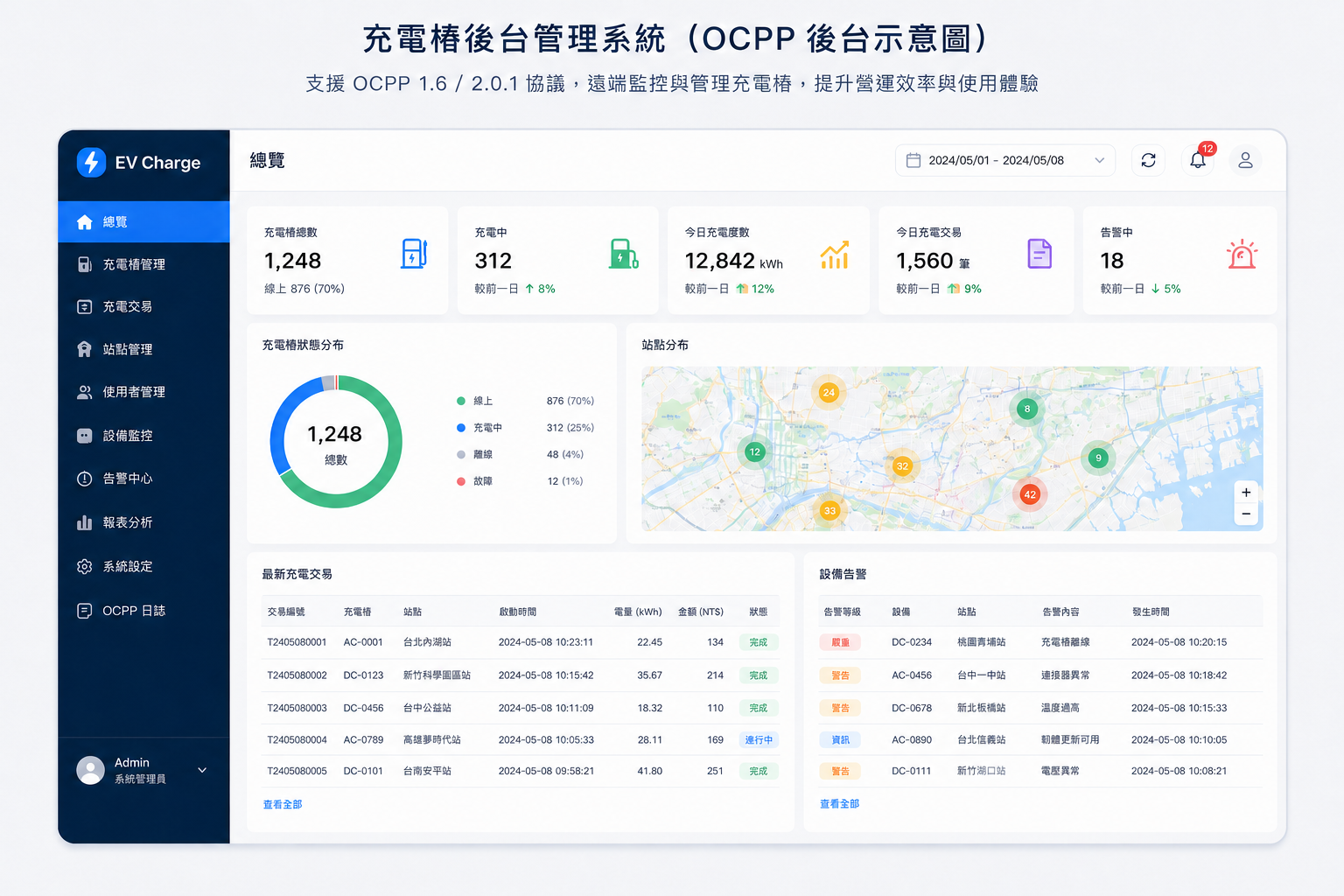
(This picture is a schematic diagram)
OCPP was developed by the Open Charge Alliance (OCA), a Dutch non-profit organization. It has since become the world's most widely adopted open EV charging standard, recommended or mandated by the EU, the United States, Taiwan, and many other markets.
| Item | Details |
| Developed by | Open Charge Alliance (OCA) |
| Scope | Global major markets |
| Protocol type | Open standard (free to use) |
| Core function | Two-way communication between charger and back-end |
2. Why Does OCPP Matter?
|For General Consumers / EV Drivers
Have you ever been unable to find a nearby charging station because a particular brand's app doesn't cover your area? This often happens when chargers don't use a unified open protocol.OCPP-compatible chargers can connect to multiple charging network platforms, meaning fewer apps and more available charge points. The future of "EV roaming" — charging across different networks seamlessly — is also built on OCPP.
|For Enterprise Procurement Managers
When deploying a corporate charging site, the biggest risk is being locked into a single vendor. If a charger doesn't support OCPP, replacing the back-end system or adding equipment from other brands later becomes extremely costly.
💡 OCPP-compatible equipment means you can freely choose your back-end management vendor. Expanding or switching systems in the future won't require replacing hardware — protecting your investment.
|Four key advantages of OCPP support
- Lower maintenance costs:A unified protocol makes back-end integration easier, reducing custom development expenses
- Greater reliability:Remote monitoring, auto-restart, and load balancing all rely on OCPP commands
- Regulatory alignment:The EU's AFIR regulation and Taiwan's EV charging infrastructure plans both recommend open-protocol equipment
- Smart grid integration:OCPP 2.0.1 supports V2G (Vehicle-to-Grid) and dynamic load management
Want to learn more about charging station or facility planning? Feel free to contact our professional consultants!
3. OCPP 1.6 vs. OCPP 2.0.1 — What's the Difference?
Two versions currently dominate the market, each suited to different use cases. Here's a quick comparison:
| Feature | OCPP 1.6 | OCPP 2.0.1 |
| Release year | 2015 | 2020 (ongoing updates) |
| Market adoption | Most widely used today | Rapidly growing |
|
Security |
Basic TLS encryption | Enhanced Security Profiles |
|
Smart charging |
Basic support | Advanced load management, ISO 15118 integration |
|
V2G support |
Not supported | Supported |
|
Device management |
Simpler | Full device certification framework |
|
Best for |
Existing site upgrades, budget-conscious deployments | New sites, future-proof deployments |
*Recommendation: Prioritize OCPP 2.0.1 for new charging sites. If existing equipment already supports 1.6, no forced upgrade is needed short-term — but confirm with your vendor whether a firmware upgrade path to 2.0.1 exists.
4. Who Should Care About OCPP?
(Image source: Official website of Siraya National Scenic Area Administration, Tourism Administration, Ministry of Transportation and Communications)
|Home Charger Installers
If you're simply charging at home with no need for remote management, OCPP is less critical. However, if your residential community plans to build a shared charging system — or if you want to monitor energy usage via a mobile app — then OCPP-capable equipment is worth prioritizing.
|Businesses, Office Buildings & Parking Operators
This is the group that needs OCPP most. Large sites with many chargers and diverse users must rely on back-end systems for billing, reservations, and energy management. Equipment without OCPP support locks you into one vendor's ecosystem.
|Hotels, Malls & Tourist Destinations
Commercial venues offering guest charging need to integrate with multiple charging network platforms (e.g., USPACE, ChargePoint). OCPP compatibility is a prerequisite for that integration.
|Charging Point Operators (CPOs)
For CPOs, OCPP is the foundation for building interoperable charging networks. Without it, expanding service coverage or delivering a consistent charging experience to drivers becomes impossible.
5. How to Verify OCPP Support When Buying a Charger
The market is full of charger brands. Here are five practical ways to verify OCPP compliance:
- Check the product spec sheet:Reputable vendors clearly list "OCPP 1.6J" or "OCPP 2.0.1" in their specifications
- Ask about back-end compatibility:Request a list of compatible CSMS platforms, or confirm whether the product has passed OCA compliance testing
- Confirm the communication method:OCPP typically runs over WebSocket (JSON) or SOAP — WebSocket/JSON is the modern standard; confirm which format the device uses
- Request OCA certification documentation:Devices that have passed official OCA interoperability testing offer stronger compatibility guarantees
- Ask about the upgrade policy:Confirm whether a firmware update from OCPP 1.6 to 2.0.1 is available, to avoid costly hardware replacement down the line
*Watch out: Some vendors claim "OCPP support" but only implement a subset of features. Always ask for a Feature Profile list and verify that the functions you need — such as remote start/stop, billing, and reservations — are fully supported.
6. FAQ
Q1|Is OCPP free to use?
A : The OCPP protocol itself is open and free. Any vendor can implement it at no cost. Fees typically come from back-end system subscriptions, OCA membership, or compliance testing.
Q2|What's the difference between OCPP and OCPI?
A : OCPP governs communication between a charger and its back-end system. OCPI (Open Charge Point Interface) handles communication between different charging networks, enabling cross-platform "EV roaming." The two protocols are complementary and operate at different layers.
Q3|Do EV chargers in Taiwan need to support OCPP?
A : Taiwan's government subsidies for public charging infrastructure generally recommend OCPP-compatible equipment, and some public tenders already require it. We recommend verifying current regulatory requirements before making a procurement decision.
Q4|Can older chargers be upgraded to support OCPP?
A : It depends on the original hardware architecture. Some devices can gain OCPP support via a firmware update, but if the hardware specs are insufficient (e.g., processor or network module limitations), equipment replacement may be necessary. Contact your vendor to confirm upgrade feasibility.
Q5|Do home chargers need OCPP?
A : For purely personal home use with no need for remote management, OCPP is not required. However, if a residential community or apartment building plans to deploy a shared charging management system, OCPP-capable equipment is recommended for unified management.
Want to learn more? Contact our team of specialists to plan the right EV charging solution for your site.